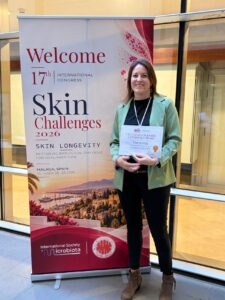
Outstanding Scientific Contribution Award 2026.
Awarded to: Elena Enzo
Università degli Studi di Modena e Reggio Emilia, Italy
Prof. Elena Enzo from the Università degli Studi di Modena e Reggio Emilia, Italy. At the 17th International Congress on Skin Ageing & Challenges in Málaga, the Scientific Board recognized Prof. Elena Enzo with the Outstanding Scientific Contribution Award 2026.
Her research addresses a fundamental question in regenerative medicine: Can we restore the regenerative capacity of ageing skin by changing the cellular environment?
Her work investigates the communication between dermal fibroblasts and epidermal stem cells. Using human cell models and integrated molecular analyses, her team demonstrated that fibroblasts with a particular extracellular matrix profile can better support epidermal stem cell renewal.
In experimental cultures, this supportive environment increased the proportion of holoclones, a marker of epidermal stem cell regenerative potential, from 12.2% to 17.6%.
The scientific importance extends beyond skin appearance. Understanding how the cellular niche regulates stem cell function may open new avenues for regenerative medicine, particularly for skin repair and grafting in older patients.
This award recognizes a contribution that connects fundamental skin biology with the future of regenerative medicine.
The Scientific Board congratulates Prof. Elena Enzo and her collaborators.
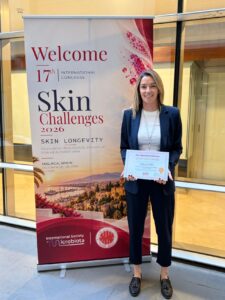
Skin Innovation Award 2026, Amazentis (Timeline)
Awarded to: Dr. Julie Faitg
Timeline® (Amazentis), Switzerland.
Recognizing innovation in mitochondrial biology and skin longevity. The Scientific Board of Skin Ageing & Challenges 2026 is pleased to recognize Timeline® (Amazentis) with a Skin Innovation Award, following the research presented by Dr. Julie Faitg, Ph.D..
The study investigated whether topical urolithin A could influence mitochondrial quality control, cellular senescence and skin ageing.
The research combined human skin cells, reconstructed 3D skin models and randomized, placebo-controlled clinical investigations.
Experimental findings indicated activation of mitophagy-related pathways, reduced inflammatory markers and changes in proteins associated with skin structure.
In a clinical study involving 48 women, topical urolithin A (1%) was associated with a reduction in periorbital wrinkle depth after eight weeks compared with placebo. A separate small study examined UVB-induced skin redness.
Why is this contribution important?
It connects mitochondrial mechanisms with measurable skin outcomes, bringing experimental skin longevity research closer to clinical evaluation.
While further clinical validation is needed, the integration of mechanistic and human evidence represents a relevant direction for the field.
The Scientific Board congratulates Amazentis, Dr. Julie Faitg and the collaborating research teams.
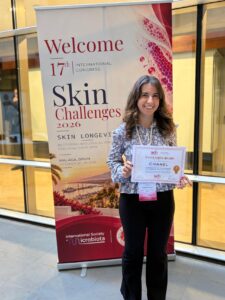
Skin Innovation Award 2026, CHANEL, France
Awarded to: Dr. Daniela Colucci
CHANEL, France
Understanding skin ageing through human genetics. The Scientific Board of Skin Ageing & Challenges 2026 is pleased to recognize CHANEL with a Skin Innovation Award for the research presented by Dr. Daniela Colucci.
Her presentation, Decoding Skin Aging in Japanese and French Cohorts: From GWAS to Biological Pathways, addressed an important question:
Are the biological mechanisms underlying skin ageing shared across populations?
The research investigated genetic associations with wrinkles, skin sagging and solar lentigines.
Using genome-wide association studies, the team analyzed 797 Japanese participants and compared the findings with data from 502 French women.
The Japanese analyses identified 14 statistically significant association signals. Further biological pathway analyses revealed mechanisms related to metabolism, cellular communication and developmental signalling, including both shared and population-specific patterns.
The significance of this contribution lies in moving from visible skin-ageing characteristics toward their underlying genetic and biological architecture.
Such research provides a foundation for more precise investigation of skin ageing and the future development of evidence-based, personalized approaches.
The Scientific Board congratulates CHANEL, Dr. Daniela Colucci and the international research collaborators involved in this work.
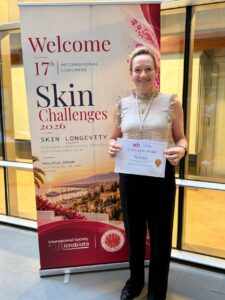
Skin Innovation Award 2026, Nofima, Norway.
Awarded to: Dr. Tone-Kari Østbye
Nofima, Norway
Exploring new mechanisms for controlling skin inflammation. The Scientific Board of Skin Ageing & Challenges 2026 is pleased to recognize Nofima with a Skin Innovation Award for the research presented by Dr. Tone-Kari Østbye.
The study investigated the potential complementary effects of cetoleic acid, a marine monounsaturated fatty acid, and the omega-3 fatty acids EPA and DHA in psoriasis-related inflammation.
Using primary human keratinocytes, reconstructed skin models and human adipocytes, the researchers examined inflammatory signalling, lipid metabolism and mitochondrial function.
The findings suggested that cetoleic acid may modulate early inflammatory pathways, including IL-17/NF-κB signalling, while EPA and DHA were associated with mechanisms involved in inflammation resolution.
Why does this research matter?
It highlights the possibility that different marine fatty acids act on complementary components of the inflammatory response.
Although clinical efficacy in psoriasis remains to be established, these mechanistic findings provide a scientific basis for further investigation of lipid-based approaches to skin inflammation.
The Scientific Board recognizes the contribution of Nofima and Dr. Tone-Kari Østbye to this emerging field.