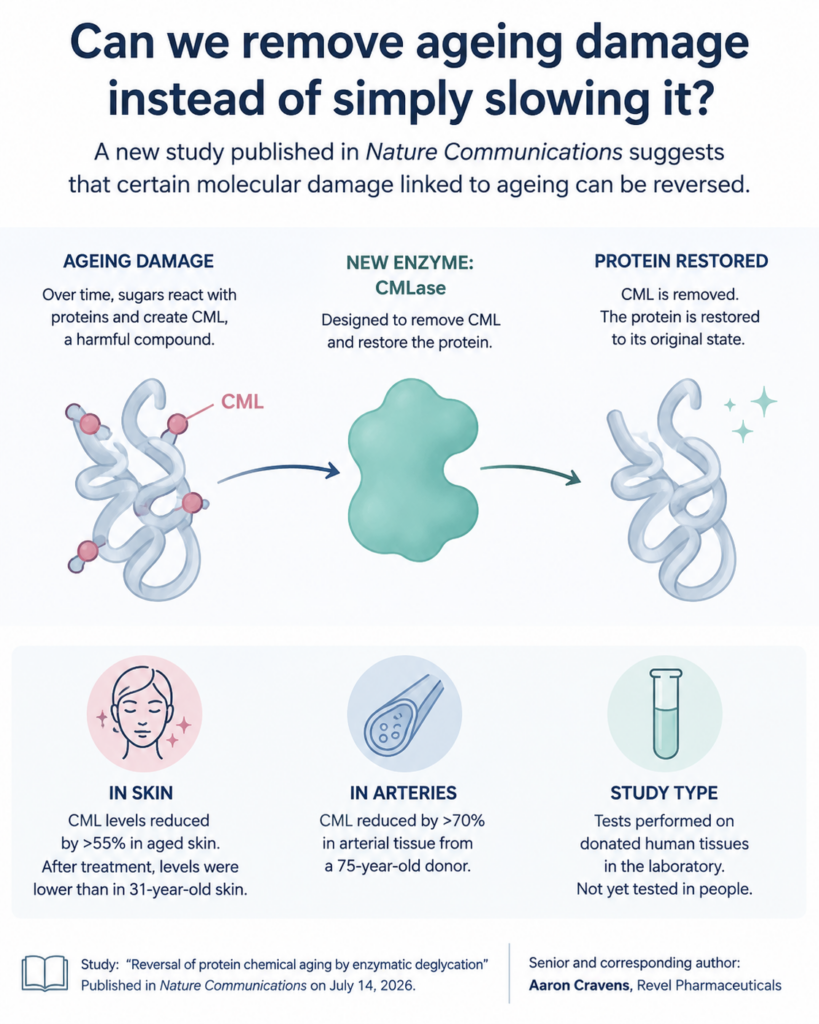
A study published in Nature Communications by Narisa Trabosh, Jason Smith, Aaron Cravens and colleagues suggests that certain forms of molecular damage linked to ageing may not be as irreversible as previously believed.
As we age, sugars gradually react with proteins in our tissues through a process called glycation.
This reaction creates advanced glycation end products, known as AGEs. These chemical modifications accumulate over time, particularly in long-lived tissues such as the skin, arteries and eyes.
One of the most common AGEs is Nε-carboxymethyl-lysine, or CML.
CML can modify the structure and function of proteins. In the skin, its accumulation is associated with greater tissue stiffness, reduced elasticity and impaired biological function. In arteries, glycation contributes to the progressive loss of vascular flexibility.
Until now, this type of protein damage was widely considered extremely difficult to reverse.
The research team, led by senior and corresponding author Aaron Cravens, developed an engineered enzyme called CMLase.
Its role is highly specific: recognize CML, remove the unwanted chemical modification and restore the original lysine residue within the protein.
To create this enzyme, the researchers screened more than 500 million variants before identifying and optimizing the most effective candidate.
They then tested CMLase on donated human tissues outside the body.
In aged human skin samples, the enzyme reduced CML levels by more than 55%. Following treatment, the level of this chemical ageing marker fell below that measured in skin from a 31-year-old donor.
In arterial tissue from a 75-year-old donor, CML levels were reduced by more than 70%.
These results are provocative, but they must be interpreted carefully.
The researchers did not reverse ageing in a living person. The experiments were conducted on isolated human tissues, and the enzyme has not yet been tested as a therapy in clinical trials.
Important questions remain concerning safety, delivery into tissues, immune reactions, durability of the effect and possible unintended consequences.
Nevertheless, the study represents a potentially important conceptual shift.
Most anti-ageing strategies aim to prevent, slow or compensate for molecular damage.
This work proposes another possibility: directly removing damage that has already accumulated.
The future of skin longevity may therefore involve not only protecting the skin from ageing, but also repairing selected chemical changes already present within its proteins.
The paper, “Reversal of protein chemical aging by enzymatic deglycation,” was published on July 14, 2026, in Nature Communications.
This emerging approach will be among the scientific questions discussed at Skin Ageing & Challenges 2026, taking place on October 28–29 in Málaga.
Read the full news here
Read the news on LinkedIn
Share this with your circle