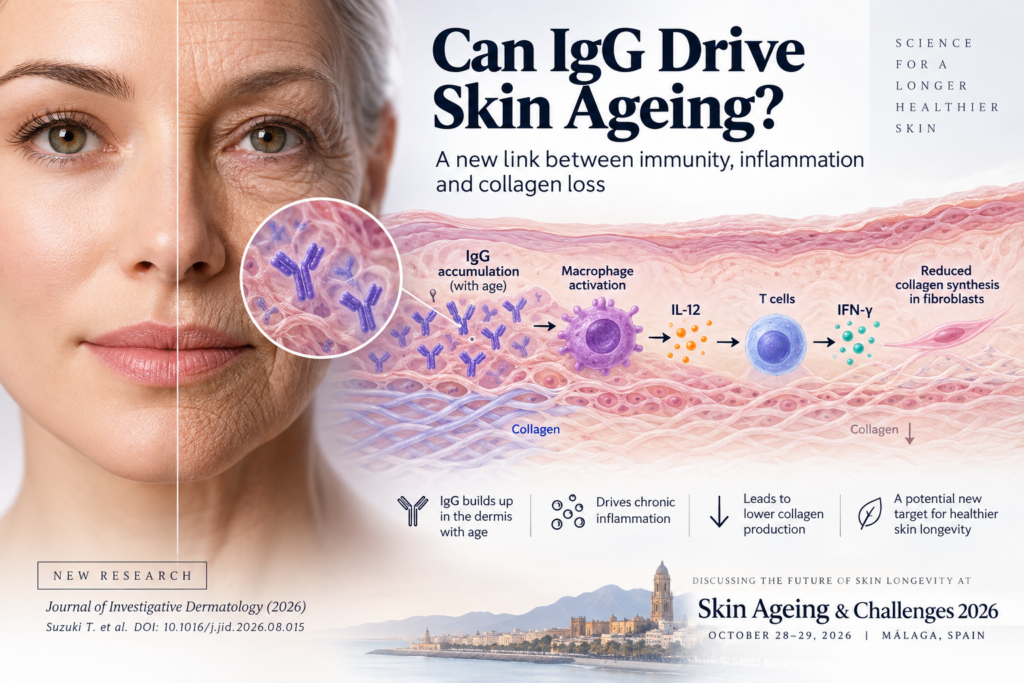
What if part of skin ageing begins with an antibody accumulating in the dermis?
A new study published online in the Journal of Investigative Dermatology on September 10, 2026, suggests an unexpected connection between immunoglobulin G (IgG), chronic inflammation and the progressive loss of collagen in ageing skin.
Takehisa Suzuki, Haruki Horiguchi, Yuichi Oike and colleagues at Kumamoto University investigated whether IgG, already known to accumulate in several organs during ageing, might also build up in the skin.
Their results suggest that it does.
Using both mouse and human tissues, the researchers observed increasing IgG accumulation in the dermis with age. In the human samples, IgG staining was very low in the two youngest individuals and increased in older samples, with a positive association between age and dermal IgG accumulation. main.pdf
But the study goes further than simply identifying a new ageing marker.
The researchers propose a biological cascade in which accumulated IgG activates macrophages, stimulating chemokines and IL-12. This promotes immune-cell recruitment and encourages T cells to produce IFN-γ. IFN-γ, in turn, reduces the expression of collagen genes in dermal fibroblasts. main.pdf
In simplified terms:
IgG accumulation → macrophage activation → IL-12 → T cells → IFN-γ → reduced collagen synthesis
The graphical model presented by the authors illustrates skin ageing as a progressive immune–stromal dialogue: IgG accumulation increases, inflammatory signalling becomes chronic, and fibroblast collagen production declines. main.pdf
More than an inflammation story
This work raises an important question for skin longevity: could ageing partly result from a progressive distortion of communication between the immune system and the cells responsible for maintaining dermal structure?
Rather than viewing collagen loss only as a downstream consequence of time and accumulated damage, the study identifies a potential upstream immune mechanism contributing to dermal deterioration.
The authors suggest that reducing IgG accumulation or interfering with downstream signalling could eventually represent a strategy for preserving skin tissue healthspan. They specifically discuss FcRn biology as a possible therapeutic direction. main.pdf
The findings remain preclinical. The human component involved only seven skin samples, obtained from patients undergoing biopsies for skin cancer or epidermal cysts, and the authors emphasize that the proposed IL-12/IFN-γ causal pathway still requires direct validation in aged animals. main.pdf
Nevertheless, the study adds an intriguing new dimension to the biology of skin ageing: maintaining skin longevity may depend not only on preserving individual cells, but also on preserving the quality of the biological dialogue between them.
This emerging concept of immune–fibroblast communication and tissue homeostasis will be among the questions discussed during Skin Ageing & Challenges 2026 – Skin Longevity, October 28–29, 2026, in Málaga, Spain.
Reference
Suzuki T, Horiguchi H, Yamamura S, et al. Aging-related IgG accumulation promotes skin inflammation. Journal of Investigative Dermatology. 2026. DOI: 10.1016/j.jid.2026.08.015
For more information:
Read the news on LinkedIn
Share this with your circle