When Repair Becomes Ageing: Cellular Senescence, Wound Healing and Skin Longevity
When Repair Becomes Ageing: Cellular Senescence, Wound Healing and Skin Longevity
Mikołaj Ogrodnik, Ludwig Boltzmann Institute for Traumatology, Austria
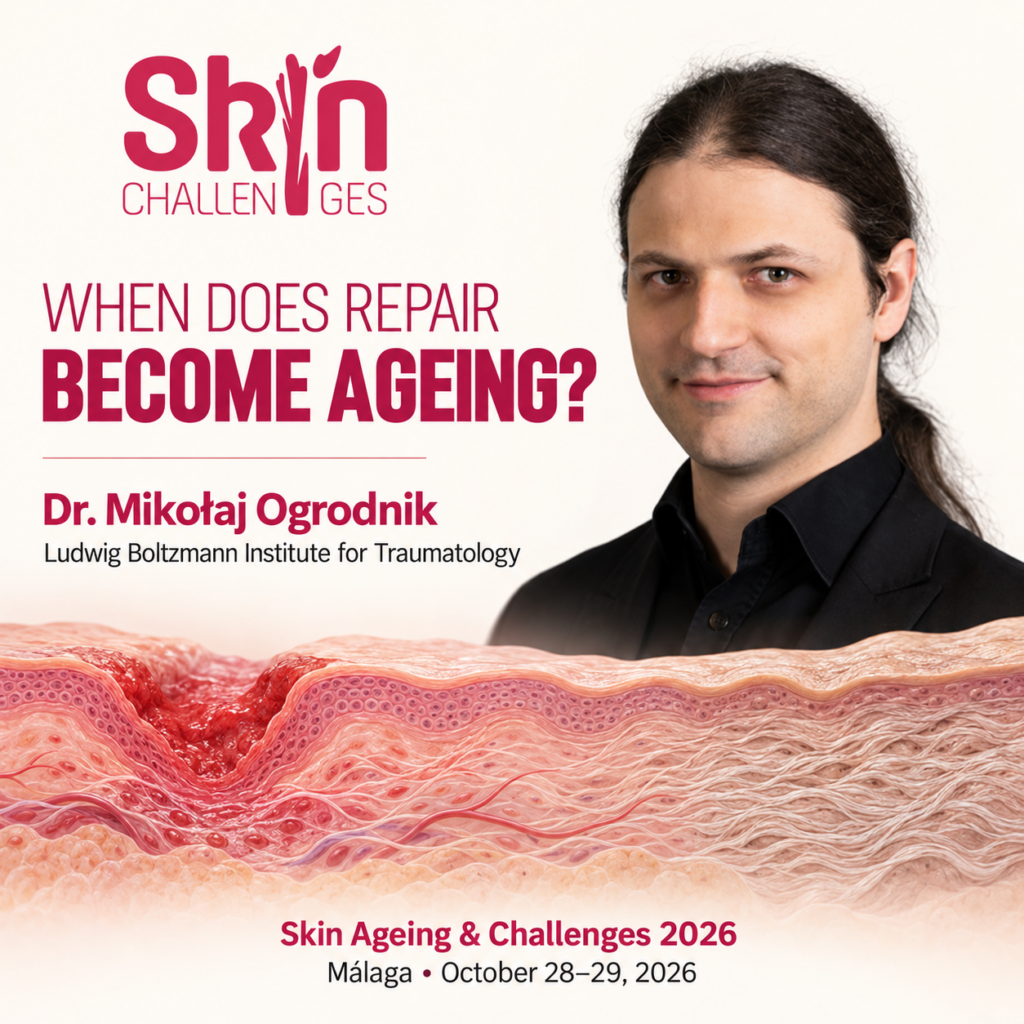
We are delighted to welcome Dr. Mikołaj Ogrodnik from the Ludwig Boltzmann Institute for Traumatology, Austria, as a speaker at Skin Ageing & Challenges 2026.
Following injury, the skin activates a precisely coordinated repair program. Cells change their state, inflammatory and metabolic signals appear and the tissue begins rebuilding itself.
Most wounds resolve. Others progress toward persistent inflammation, fibrosis or chronic dysfunction.
What determines the difference?
Dr. Ogrodnik investigates how cellular senescence, mTOR signaling and local tissue environments influence the outcome of wound healing. His work examines how early and late senescence programs can guide the skin either toward regeneration or toward prolonged remodeling.
Talk
When Repair Becomes Ageing: Cellular Senescence, Wound Healing and Skin Longevity
Dr. Ogrodnik will present how single cell transcriptomics, tissue engineering and experimental models can reveal the cellular and metabolic switches that shape skin repair.
Understanding when a beneficial repair response becomes maladaptive could identify new opportunities to improve healing while preserving skin longevity.
Summary of Talk:
Tissue injury triggers coordinated repair programs that unfold across time and space, yet the mechanisms determining whether damage resolves through regeneration or progresses to chronic dysfunction remain incompletely understood. We recently investigated how injury-induced cellular states, particularly distinct early-onset senescence programs and the rapid induction of mTOR signaling, intersect with aging to shape wound-healing outcomes.
This research defines injury-associated signaling zones and maps their spatiotemporal dynamics to elucidate how local microenvironments guide cell-fate decisions during acute repair and persistent remodeling. We have examined the roles of early versus late senescence in directing tissue recovery and identified molecular and metabolic switches, including ribosomal signaling, that bias healing toward restoration or fibrosis in skin. In those studies, we integrated transgenic and wild-type preclinical models of wound healing and aging with tissue engineering and bioinformatics approaches, including single-cell transcriptomics. Collectively, these experimental strategies offer promise for advancing our understanding of the molecular mechanisms governing cutaneous damage responses and may enable their modulation to improve healing and skin longevity.
Skin Ageing & Challenges 2026
October 28–29, 2026, in Málaga, Spain
www.skin-challenges.com