Restoring Regenerative Capacity in Aged Skin: From Cellular Signals to Cell-Free Therapies
Restoring Regenerative Capacity in Aged Skin: From Cellular Signals to Cell-Free Therapies
Hugo Agostinho Machado Fernandes, Universidade de Coimbra, Portugal
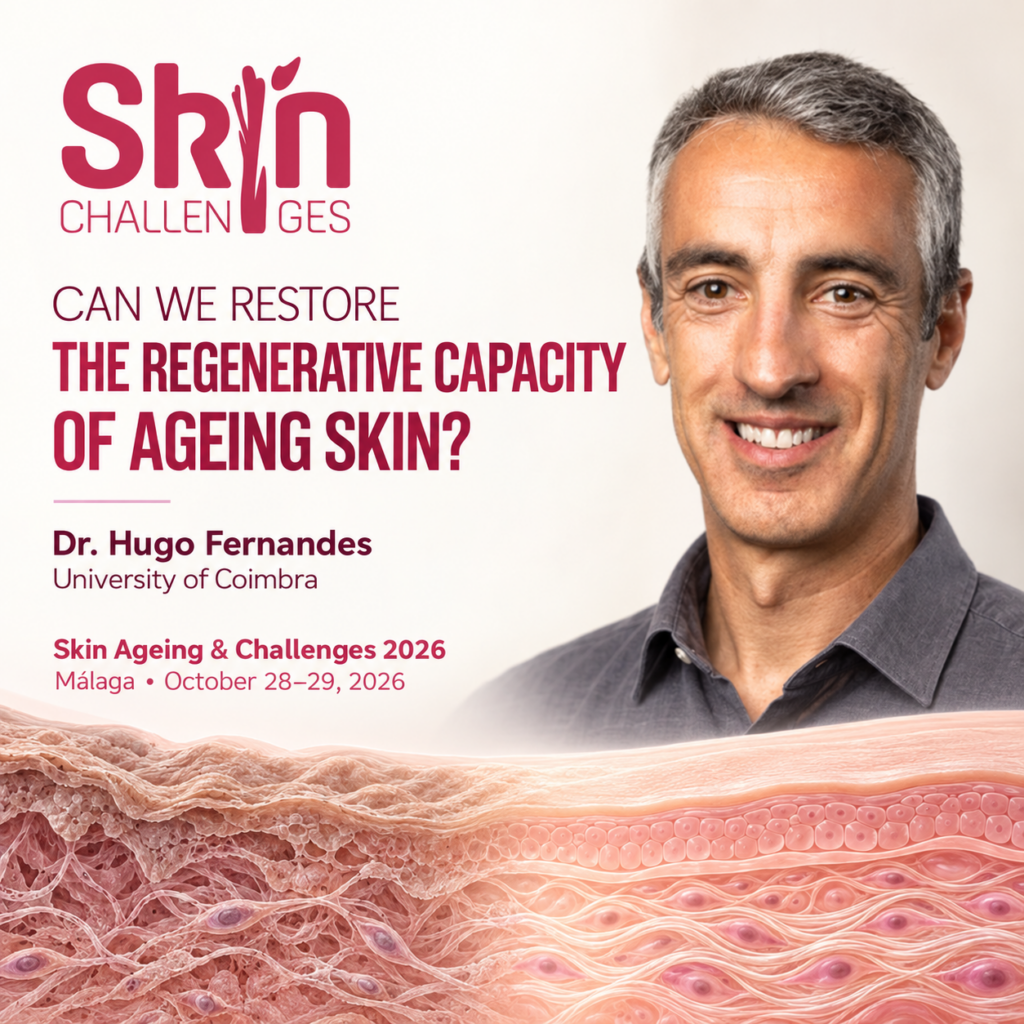
We are delighted to welcome Dr. Hugo Fernandes, Principal Investigator at the University of Coimbra, Portugal, as a speaker at Skin Ageing & Challenges 2026.
As skin ages, its capacity to repair and regenerate gradually declines. Cellular communication changes, wound healing becomes slower and the biological signals required for tissue renewal lose their effectiveness.
Can these signals be restored?
Dr. Fernandes leads research at the intersection of cellular ageing, regenerative medicine and extracellular vesicles. His work explores how biologically active molecules, including microRNAs carried by extracellular vesicles, can influence cell survival and tissue regeneration.
Talk
Restoring Regenerative Capacity in Aged Skin: From Cellular Signals to Cell-Free Therapies
Dr. Fernandes will examine how understanding communication between cells could inspire new cell free strategies to restore the regenerative potential of ageing skin.
His contribution reflects one of the central ambitions of Skin Ageing & Challenges 2026: moving from the study of ageing mechanisms toward innovative approaches that preserve skin function, repair and longevity.
Skin ageing is a multidimensional process driven by the convergence of intrinsic biological changes and environmental stressors. These alterations progressively disrupt epidermal barrier integrity, compromise extracellular matrix (ECM) homeostasis, and establish a chronic low-grade inflammatory state that significantly impairs tissue repair. Consequently, aged skin represents a particularly vulnerable substrate for delayed or chronic wound healing, a condition that disproportionately affects elderly populations and imposes a substantial clinical and socioeconomic burden.
This presentation explores the potential of cell-free therapies to enhance wound healing in aged skin, focusing on the secretome as a novel therapeutic platform. We will examine the critical role of extracellular vesicles (EVs) and their molecular cargo in mediating intercellular communication within both healthy and aged skin environments. Building on this foundation, we will discuss: (i) how biomolecular engineering strategies can be designed to modulate interactions between skin-derived cells, (ii) how to identify microRNAs (miRNAs) capable of restoring skin functionality and finally (iii) innovative approaches to engineer EVs enriched with these pre-selected miRNAs. Ultimately, we propose that targeted miRNA interventions present a promising therapeutic strategy to accelerate tissue repair and potentially delay or revert the skin ageing process.
Lay summary
As we age, our skin loses its ability to heal efficiently, making older adults prone to severe, hard-to-treat wounds. This presentation explores new treatment approaches that use tiny “messenger” particles instead of whole cells to promote healing. Cells normally use these messengers to transfer biological information with one another. By engineering the cargo of these particles with pre-selected molecules/drugs, we can delay/revert some of the hallmarks of ageing skin ultimately improving wound healing and skin function.
For more information:
Read the news on LinkedIn
Skin Ageing & Challenges 2026
October 28–29, 2026 – Málaga, Spain
www.skin-challenges.com