The Skin Volatolome: Can Volatile Signatures Become Non-Invasive Biomarkers of Skin Ageing?

The Skin Volatolome: Can Volatile Signatures Become Non-Invasive Biomarkers of Skin Ageing?
Aoife Morrin, Dublin City University, Ireland
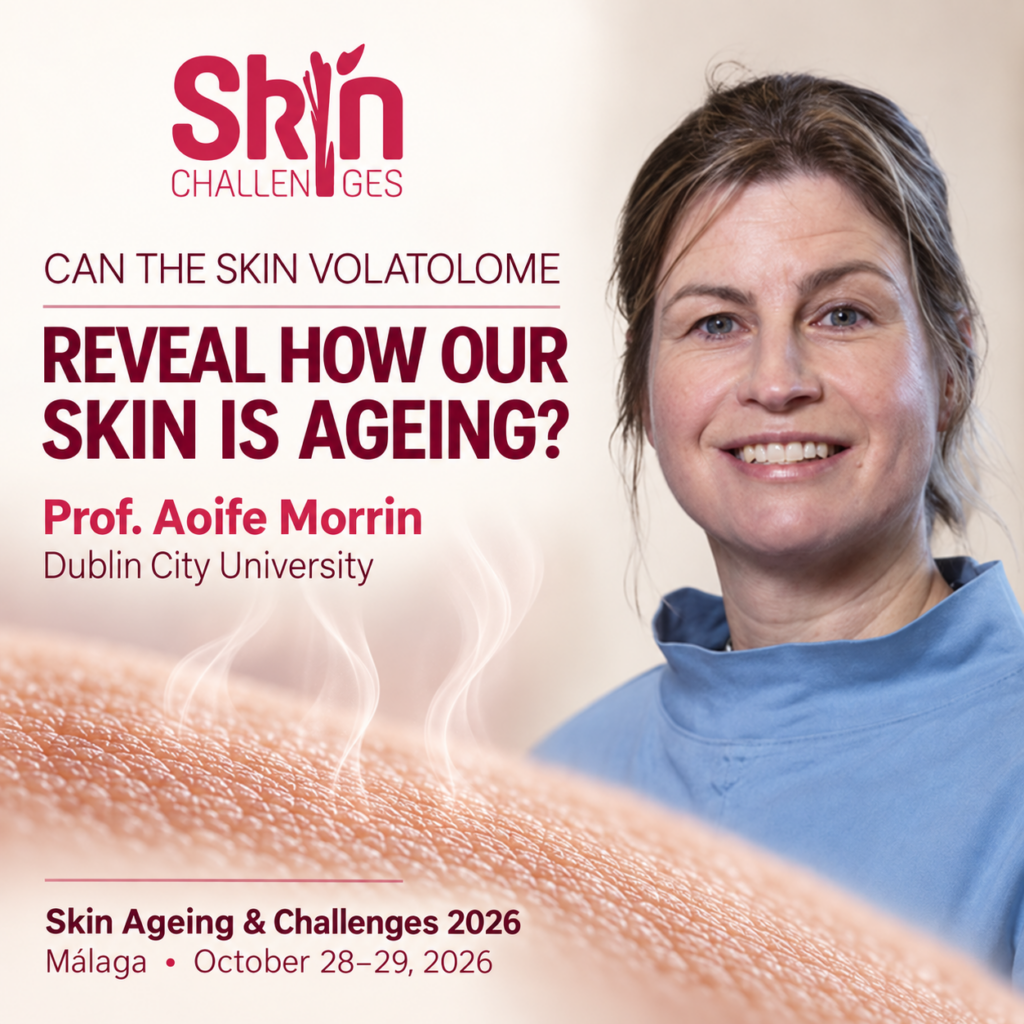
We are delighted to welcome Prof. Aoife Morrin from Dublin City University, Ireland, as a speaker at Skin Ageing & Challenges 2026.
The skin continuously releases volatile organic compounds. Could these invisible molecular signals tell us something about skin barrier function, inflammation, environmental exposure and ultimately biological skin ageing?
Prof. Morrin’s research combines chemical sensing, wearable technologies and noninvasive biological monitoring. Her participation will bring an original perspective to one of the meeting’s central questions: how can we measure changes in skin health before they become visible?
Featured Lecture
The Skin Volatolome: Can Volatile Signatures Become Noninvasive Biomarkers of Skin Ageing?
Her lecture will explore the potential of skin volatile signatures as accessible biomarkers and their future integration into wearable sensing platforms for continuous and personalized monitoring.
This contribution will be part of our discussion on the next generation of noninvasive tools for skin longevity, from understanding biological mechanisms to measuring them in real time.
Summary
The skin surface emits a rich mixture of volatile organic compounds (VOCs) arising from sebaceous secretion, epidermal lipid metabolism and the resident skin microbiome, offering a chemical window into skin physiology that can be sampled non-invasively. My talk will review our group’s work profiling this skin volatolome across different populations. I will begin with our work identifying volatile signatures associated with skin ageing and their potential as non-invasive biomarkers of skin conditions. I will then discuss our work applying VOC profiling to skin barrier function, including changes in the volatile profile following topical treatments such as salicylic acid, and to infection diagnostics in diabetic foot ulcer wounds, where volatile signatures reflect the underlying wound microbiome. Across these applications, I will highlight our finding from gas chromatography-mass spectrometry (GC-MS) analysis, that underpin reliable VOC measurement in clinical and cosmetic settings. Together, this body of work asks what is needed to move from volatile signatures as proof-of-concept findings towards validated, non-invasive biomarkers of skin health, ageing and wound care.
For more information:
Read the news on LinkedIn
Skin Ageing & Challenges 2026
October 28–29, 2026 – Málaga, Spain
www.skin-challenges.com